
American University of Mongolia Introduces Data.mn, a Free, Bilingual Home for Mongolia's Public Data
Built at AUM and expanded every semester by student interns, Data.mn brings 178 datasets on Mongolia into one easy-to-use site, in English and Mongolian, for people and AI agents alike.
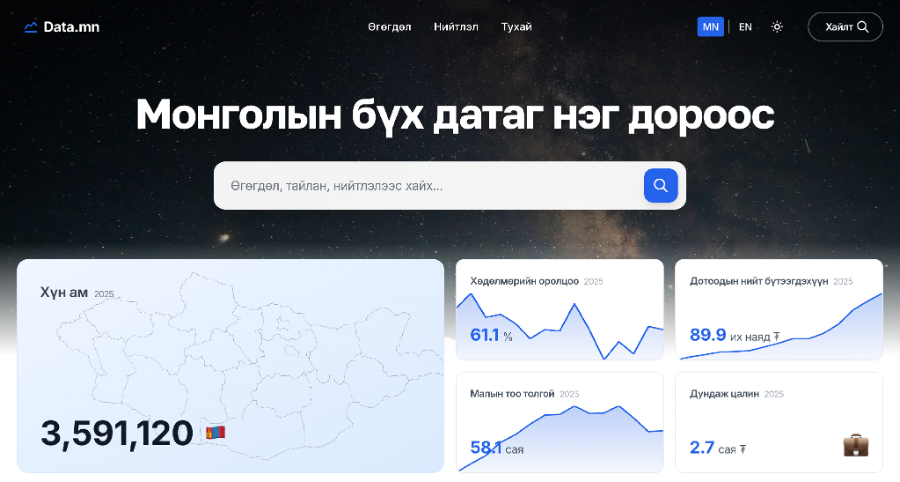
The American University of Mongolia (AUM) today announced Data.mn (https://data.mn), a free open data platform that collects public statistics about Mongolia and presents them in one place, in both English and Mongolian. The site currently hosts 178 datasets across 18 topics, from GDP, inflation and wages to livestock counts, air quality and parliamentary attendance. Every dataset has an interactive chart, a short plain-language description, a link to the original source, and free CSV and Excel downloads.
Data.mn was created by Robert Ritz on behalf of AUM. It started with a simple problem. Mongolia's government agencies publish a lot of useful data, but much of it is hard to find, hard to use, or buried in PDF reports. A journalist looking for the latest unemployment rate, or a student who needs 30 years of GDP figures, often has to dig through several websites and spreadsheet formats before getting a usable answer. Data.mn does that work once so nobody else has to: it collects the data, cleans it, splits large multi-dimensional tables into focused datasets that each answer one question, and translates everything so it reads naturally in both languages.
Data on the site comes from official sources, including the National Statistics Office of Mongolia (1212.mn), the Bank of Mongolia, the Mineral Resources and Petroleum Authority of Mongolia (MRPAM), the national air quality portal (agaar.gov.mn), the Ulaanbaatar eBarilga geoportal, opendata.gov.mn and the State Great Khural. Data.mn is not a government website. Every dataset names its source, links back to the original, and shows when it was last updated, so anyone can check the numbers.
Built by AUM students
Each semester, AUM students join the Data.mn team as interns. They find new datasets, build charts, translate between English and Mongolian, check figures against the original sources, and update datasets when agencies release new numbers. The work happens in a real codebase with code review, version control and automated data validation, and everything they produce is published to a public audience.
"Mongolia has a lot of good public data. The problem is having it all in one place where it is searchable, easily downloadable, and easy to use," said Robert Ritz, co-founder and President of the American University of Mongolia. "I wanted a site where a student, a reporter or someone working at a company could find a number, see exactly where it came from, and download it in under a minute. Having AUM interns build it each semester means the site keeps growing, and our students get to do real work that people outside the classroom actually use."
Built for AI agents, too
More and more people now get their answers by asking AI assistants instead of searching the web. Data.mn is designed so those assistants can read it directly and accurately:
• An index for AI agents. A machine-readable guide at data.mn/llms.txt lists every dataset and explains how to access it.
• Clean Markdown versions of every page. Adding .md to any data or insights page URL (or requesting the page with an Accept: text/markdown header) returns a plain Markdown version with the data as a table. For a typical dataset page this is about one-ninth the size of the HTML page, so an AI agent can read more data with less effort and fewer errors.
• Direct downloads at predictable addresses. Every dataset is available as CSV in English and Mongolian and as an Excel file, at URLs that follow a simple pattern.
• Links that don't break. When a page is renamed, the old address redirects to the new one, so links in reports, articles and AI answers keep working.
"If AI tools are going to answer questions about Mongolia, I'd rather they pull from clean, sourced numbers than out of date international reports," Ritz said. "Making the site easy for agents to read was not much extra work, and it means the data reaches people who never visit the site directly via tools like ChatGPT and Claude."
Availability
Data.mn is free to use for any purpose, including research, journalism, teaching and business, with no account or registration required. The English site is at https://data.mn/en and the Mongolian site is at https://data.mn/mn. Users are encouraged to cite both Data.mn and the original government source. Suggestions for new datasets and corrections can be sent to robert@aum.edu.mn.
Media contact
Robert Ritz
American University of Mongolia